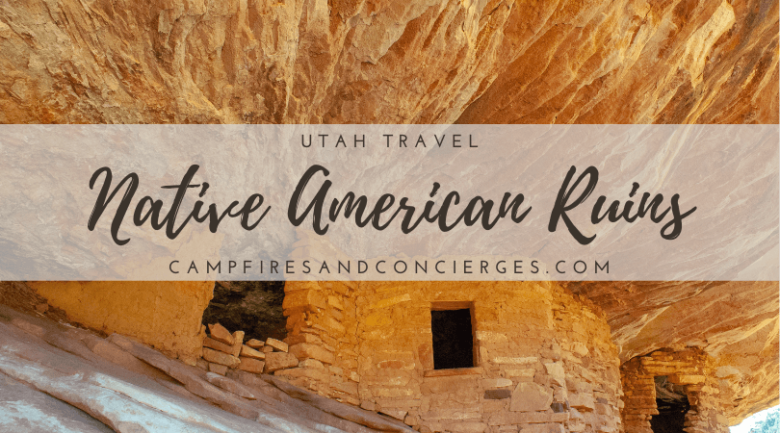
One of the coolest things about the Southwest United States is how well-preserved some of the Native American ruins are. I loved visiting Indian ruins in Arizona, so once I moved to Utah, I also wanted to experience the Native American history and ruins that remain scattered throughout Southeastern Utah. Like Arizona, Utah has many very different climates and landscapes, so different types of Native groups moved through the area and called Utah home. The majority of the sites in Southeast Utah are from the Ancestral Puebloan ruins, sometimes called Anasazi. Different types of Indian ruins in Utah include cliff dwellings, pueblos, kivas, and rock art. These are just a few of the better-known sites that I’ve visited so far.
This post contains affiliate links. Buying through these links will not cost you extra, but I will earn a small commission.


Unlike the ruins I visited in Arizona and at Colorado’s Mesa Verde, many of the sites in Utah are not gated up in a park. You can hike to ruins in Utah and have nobody around for miles. This means the stewardship of these gems is up to all of us. It’s crucial that we hold ourselves accountable to preserve these places for generations to come. That means:
- Don’t touch anything
- Don’t take anything
- Don’t leave anything
Learn more about Leave No Trace principles from REI
Hovenweep National Monument
This National Monument sits on the border of Utah and Colorado, just one hour from Mesa Verde (the best place to see ruins in Colorado!) The site includes the ruins of six prehistoric villages from the Ancestral Puebloan (Anasazi) period. The Square Tower Group includes the largest of structures, and this is also where you will find the Visitor Center and the campground.

Explore all of Utah’s National Monuments!
Natural Bridges National Monument
This National Monument is way off the beaten path, which means you’ll have fewer crowds to contend with. Located one hour west of Blanding, this monument features three natural bridges. It’s a fairly small National Monument, with a one-way loop road going through the park, with several scenic overlooks and pullouts where you can view the arches and ruins. There are many hiking trails through the monument as well, including the 8.6-mile trail that connects all three natural bridges in addition to Horse Collar ruins. If you are looking for interesting hiking trails without the crowds of Utah’s National Parks, this is a great place to go! While the location is remote, it’s in the center of many ruin sites as well as not far from Lake Powell’s ferry.

Don’t miss the Moki Dugway, one of the best scenic drives in Utah!
Canyonlands National Park
The craziest thing about all the ruins in Utah is that there are more hidden in so many places. The ones most people know about, like the ones in this post, are easily accessible. But if you’re willing to travel into the backcountry, there are many more sites and lots more artifacts that have been left behind. Canyonlands is a great place to look for Utah cliff dwellings. My first trip to Utah was a rafting trip through Canyonlands, and our guide took us on some incredible hikes to old granaries and pictographs. Canyonlands really is a hidden gem with an incredible backcountry.
Check out all the cool things to do in Moab!

Edge of the Cedars State Park Museum
This state park museum in Blanding is a great place to start your exploration of Southeast Utah. Set on the site of a restored pueblo, the museum has a great overview of the history of the area and the people who lived there. Start with the short film before exploring the extensive collection of artifacts. My favorite part of the museum was the display showing how different people just stumbled upon pottery and ruins while out on a hike. Can you imagine? So cool!

Outside the museum, there’s a restored pueblo and a kiva that you can actually climb inside. There’s a short path through the ruins with interpretive signs. The museum is a great mix of indoor displays and outdoor ruins.
Bears Ears National Monument
Many Americans probably never heard of Bears Ears until it was established as a National Monument in 2016. Bears Ears became a household name in 2017 when President Trump reduced the size of the National Monument by 85%. The size reduction was highly controversial because the Bears Ears area is rich with historic sites, and it’s an important part of local Native culture. There are over 100,000 archaeological sites throughout the monument.

Mule Canyon is one of the most well-known archaeological sites in Bears Ears. There is a roadside interpretive site known as the Mule Canyon Roadside Ruins, which includes a restored kiva. My favorite, though, is the House on Fire Ruin. It’s a two-mile round-trip hike, which helps to keep the crowds down. (Although I’m told by a local ranger that it’s definitely getting more attention recently.) I only learned recently that there are more ruins and a tower on the trail, so I’ll have to return again for a longer hike.

There is a Bears Ears Visitor Center in the town of Bluff, but it was closed when we last visited. Make sure you do your research ahead of time and download or print any maps, as you’ll be out of cell range in most areas. From here, it’s also a short road trip to Monument Valley.
Comb Ridge / Butler Wash
Another Utah destination rich with ruins is the Cedar Mesa area which includes Butler Wash and Comb Ridge. The ridge is a cool geological feature that you can drive through on Highway 163, and Butler Wash runs adjacent to the ridge. Within the wash, there are dozens of archaeological sites and ruins. Once you turn off the main highway (163) you will be on a dirt road. Popular Butler Wash ruins in this area include the Wolfman Panel, Double Stack Ruin, Procession Panel, Monarch Cave, Cold Spring Cave, Split Level Ruin, and Fishmouth Cave. I highly recommend hiring a local guide to take you back here. We booked a tour with Louis from Ancient Wayves; he grew up on the Navajo reservation and added so much more insight to the ruins than we would have gotten on our own. Seeing a destination through a local’s eyes is always preferable, especially when you’re on Native land.

Petroglyphs in Utah

Besides all of the cool native ruins in Utah, there are even more places where you can see pictographs and petroglyphs in Utah. Collectively called “rock art,” pictographs are painted on the rock, while petroglyphs are carved into the rock. Some great places to see petroglyphs in Utah include:
- Nine Mile Canyon near Wellington
- Potash Road near Moab
- Wolfe Ranch in Arches National Park
- Sand Island Petroglyphs on the river near Bluff
- Newspaper Rock near Monticello
- Dinosaur National Monument near Vernal
- Parowan Gap Petroglyphs
Find fun things to do in Vernal Utah aka Dinosaurland!
- Slot Canyon & Petroglyphs UTV Adventure (Private)

- Price: $128.00

- Tour Monument Valley with a Navajo guide TSNGT

- Price: $65.00
Hi Leigh!
House on Fire Ruins is absolutely STUNNING. I trust all is well.
Keep on treckin.
TC
Thanks, TC!
This guide to Indian ruins is incredibly helpful. You’ve really thought through everything you need to know before planning a trip. Thank you for this helpful resource. Saving this guide for later!
I have found Petroglyphs south of Hinckley, Utah off to the east of the highway to Milford. East of the RR tracks a few miles north of Kaufman Ranch.
santaquinkid@outlook.com