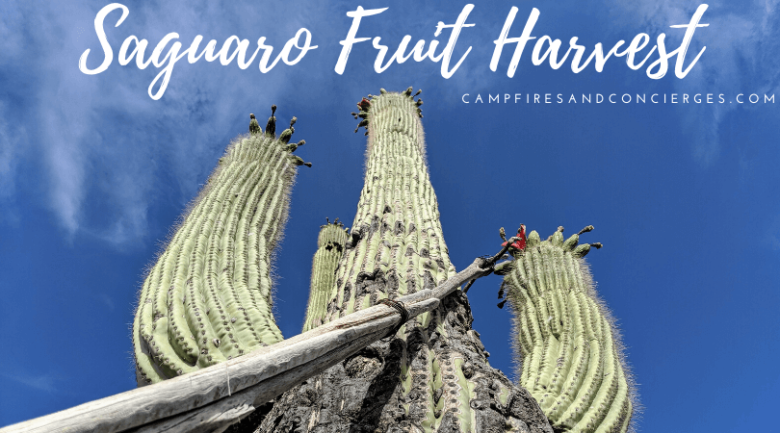
One of my favorite things about Southern Arizona is the presence of Saguaro cactus. Anytime I leave Tucson, even for a short time, I miss seeing these giant cactus dotting the landscape. My other favorite thing about the Sonoran Desert is watching the seasons pass by. The seasons in Arizona aren’t as drastic as where I grew up in the Midwest, but they’re still evident if you pay attention. Each type of cactus has a bloom and fruit season, and the Saguaro cactus fruit is one of the most impressive.

Harvesting the saguaro cactus fruit is a time-honored tradition of the Tohono O’odham Nation and I was lucky enough to be invited to a saguaro fruit harvest at Colossal Cave Mountain Park this summer. There are very limited opportunities for non-Native Americans to harvest the fruit of saguaro cactus; if you get the chance, go!
This post contains affiliate links. Buying through these links will not cost you extra, but I will earn a small commission.
Saguaro Cactus Fruit
Sometime in June, the saguaro cactus starts to bloom with beautiful white flowers that also happen to be the Arizona state flower. They tend to bloom overnight and the flowers don’t last long, so it’s always a special treat when you see saguaros in bloom. Once the saguaro flower has been pollinated, it becomes a cactus fruit. The saguaro cactus fruit is in the same family as the dragon fruit, and you’ll see the resemblance if you open one up. Before it’s ripe, it has a white inside with hundreds of tiny saguaro seeds.

Tohono O’odham
The Tohono O’odham people lived in the Sonoran Desert long before a US-Mexico border was established. Today, the Tohono O’odham live on a reservation south of Tucson that encompasses over 4,000 square miles. About 8000-9000 people live on the reservation. Their culture is very much intertwined with the Sonoran Desert, and they rely heavily on the plants and animals of the area to sustain their population. Although modern conveniences continue to creep into the culture, there are still tribal elders who are doing their best to pass down the language and traditions of their tribe. One of those elders is Lois Liston, who brought her family to the Saguaro Fruit Harvest at Colossal Cave. She and others run the Ha:san Preparatory & Leadership School and work with the public at events like this in order to generously share their culture.
The Tohono O’odham people have many legends around the Sonoran Desert. The saguaro cactus plays an important role in their culture and the calendar, as the harvest signifies a new year for them. The saguaro fruit is used to make wine, through an important ritual known as himdag.
Saguaro Cactus Fruit Harvest
Each summer, there is a very short window between the saguaro bloom and the monsoon seasons. This is when the Tohono O’odham people get out to harvest the saguaro fruit. In most areas of the Sonoran Desert, only Tohono O’odham members can harvest the fruit; do not go out into the desert and try this on your own as it is most likely illegal, possibly dangerous, and disrespectful to their culture. Several organizations in Southern Arizona partner with the Tohono O’odham people to allow the public to participate in a saguaro harvest. These are a few that I know of:
- Colossal Cave Mountain Park may have discontinued their event. Stay tuned…
- Arizona Sonora Desert Museum typically hosts an event in late June
- The Phoenix Desert Botanical Garden and the Desert Foothills Land Trust also partner with the Tohono O’odham for a public harvest in the Phoenix area.
- In Southwest Arizona, the Sonoran Desert Inn in Ajo holds a weekend event with a harvest in Organ Pipe Cactus National Monument.
As far as I know, there are no cactus harvest events within the National Park Service units of Arizona. Local Native American tribes may have permission to harvest within Saguaro National Park, but you cannot harvest saguaro fruits or flowers from the park.

The saguaro harvest begins before sunrise. Remember, this is July in the Sonoran Desert. It’s already 80-90 degrees by the time the sun comes up, so you want to get an early start before the temps pass 100 degrees! The first step in harvesting saguaro fruit is to get your equipment ready. The tool used for harvesting saguaro fruit is called a kuipad and it is made from fallen saguaro ribs. Of course, the kuipad is re-used year after year, so the main task today is to tighten up the cross-bars which are used to knock the ripe fruit off the saguaro.

Once our tools were ready, we split into groups and headed out into the desert to begin our traditional harvest. It’s best to have at least two people so that one can knock the fruit down, while another person collects the fruit. Apparently, it works best if you catch the fruits as they are falling, but we weren’t quite that coordinated.

It didn’t take long to learn how to distinguish the ripe fruit from the unripe, and we were soon on our way to filling a bucket with ripe saguaro fruit. We each had knives so that we could remove the fruit and leave the rest of the bud out in the field for other animals to enjoy. Once our bucket was full, it was time to head back to camp and combine our harvest with everyone else.

Traditionally, the Tohono O’odham will set up camps during the harvest, similar to hunting camps, where all of the activity takes place in one central location, making it also a chance to gather your family and reconnect over important cultural traditions. They will often stay at the camps for several days or weeks until there is no more fruit to harvest. As the fresh fruit is harvested, it’s boiled over a fire (or in our case, a propane stove) until a pulp is formed and the seeds are then removed to make a thick syrup. You can also drink the fruit juice, which is pretty tasty.

While everyone took turns stirring the pot and keeping an eye on the boiling fruit, we all grabbed some fry bread topped with powdered sugar and saguaro syrup from last year’s harvest. At this point, the festivities open up to the public, with presentations, activities, storytelling, hikes, and a chance to visit the petting zoo at Colossal Cave. Anyone who wanted could also pour a small vial of saguaro syrup to take home.
Looking for more things to do in Tucson? I’ve got you covered!
Colossal Cave Mountain Park
Besides this special event, there are a lot of fun things to do at Colossal Cave Mountain Park. There are several different cave tours (we saw a couple of coatimundi on our tour!) and a cafe, gift shop, and hiking trails around the property. In addition to the annual saguaro harvest, there are also other events like campouts, guided hikes, bird watching, and more. It’s definitely worth a stop if you are traveling through Southern Arizona, as it’s not far off I-10 on the southeast side of Tucson.